KQED · 2020, 2022
California Proposition Guide
A ballot guide you could talk to, because sometimes deciding is easier out loud.
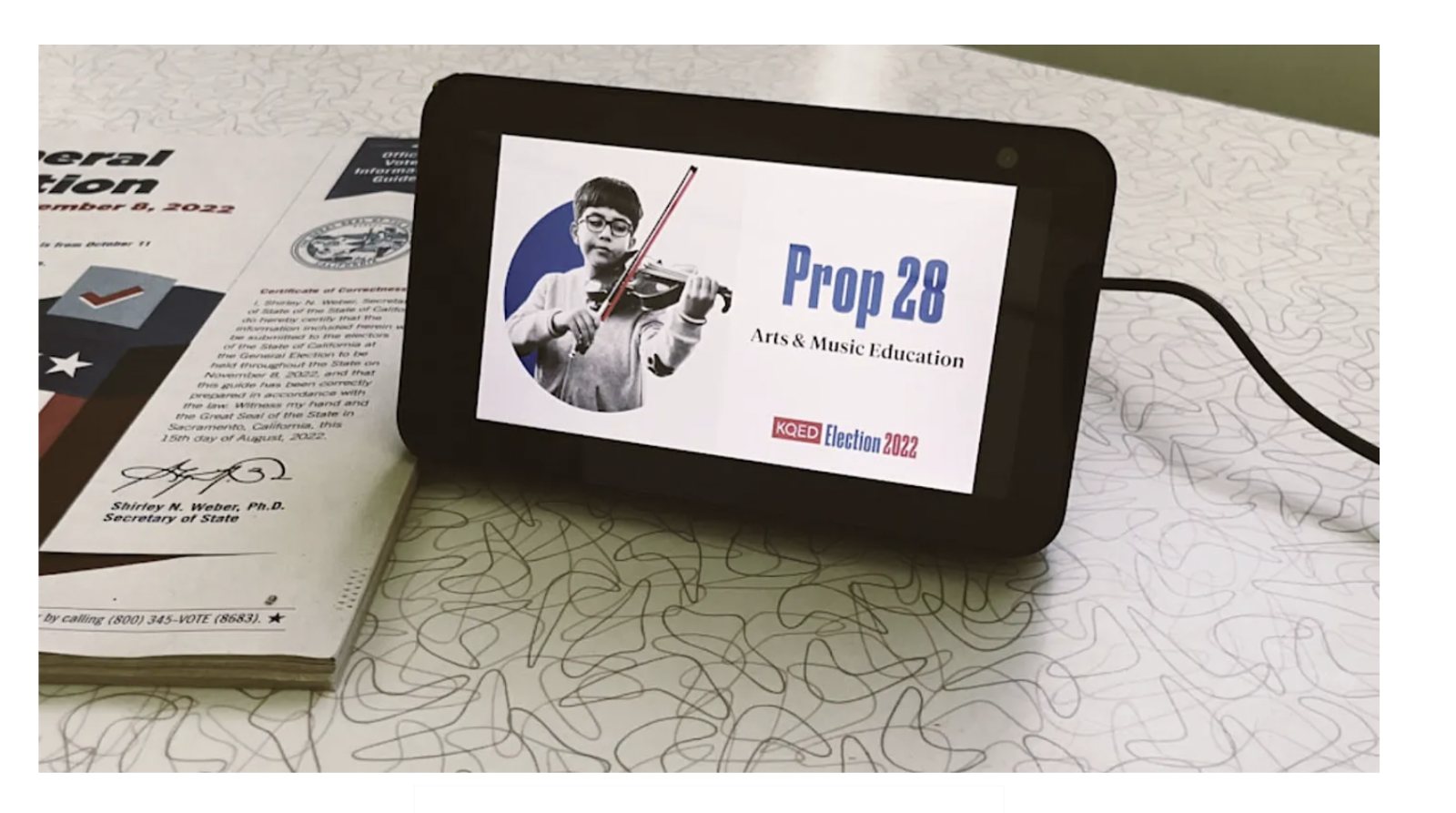
The decision
California ballots can be long, hard, complicated. Helping the public understand what’s on the ballot is the Super Bowl for public media. Election season is where eyes and ears turn to public media. In 2020 there were twelve statewide measures, each one a yes or no, and each one described in language that doesn’t always help the voter understand what a measure is about.
Every registered voter gets the official state guide in the mail. It’s thorough and it’s the record, and for most people it’s still a lot to work through. A KQED guide doesn’t replace that. It sits alongside it, for the part where you have the document and still don’t know how you’re voting.
Ballot guides are a staple at KQED. Reporters spend the run-up to an election going deep on individual measures, tracking who is funding what, what each outcome would actually change, and where the claims on both sides hold up. That reporting is careful and precise. Very few people can spend the amount of time understanding a measure the way a seasoned reporter can. So relying on a voter guide is inherent in the trust of public media.
But everyone learns in different ways. Maybe I heard something on the radio, maybe I read something. Then everything just gets reduced to a number. For some the number works, for others you may not remember that the dialysis clinic measure was Prop 23. You remember dialysis clinics.
So the design challenge of the voter guide in 2020 was how do you aid voters in the way that works best for them.
Voice is a different type of discovery
Searching by voice doesn’t necessarily rely on a results page to scan. People describe, correct and then describe again. Not having an interface to lean on is both a challenge and an advantage. Nothing is competing for your attention and nothing is proposing what you should want. The interface is whatever is already in your head.
The blank page problem
It is also the risk. A menu is a crutch, and taking it away means the first move belongs entirely to the user. A display could show you where you’d landed, but not where you could go. It worked with a screen or without one, and either way there was nothing to tap. They have to say something out loud with no model of what will work. That is the blank page problem, and it was the actual design problem here. The language processing was the easy part.
In 2020 this was still open ground. How does anyone perform a first search by voice at all? What prompt makes a person comfortable enough to speak? Everything downstream depends on that single moment, because a user who says nothing never reaches any of the content.
So by relying on the trust that our listeners already had with KQED, we kept all voice authored by personalities that everyone already knew. Keeping a casual and supportive style meant you didn’t need to arrive with the perfect thing to say. We preemptively imagined what a user might need and created a supportive framework around it.
What we built
If you knew a proposition’s number, you said the number. If all you had was the one about dialysis clinics, that worked too. Neither was the fallback. Some people hold the number, some hold the topic, and there was no reason to make either group work harder than the other.
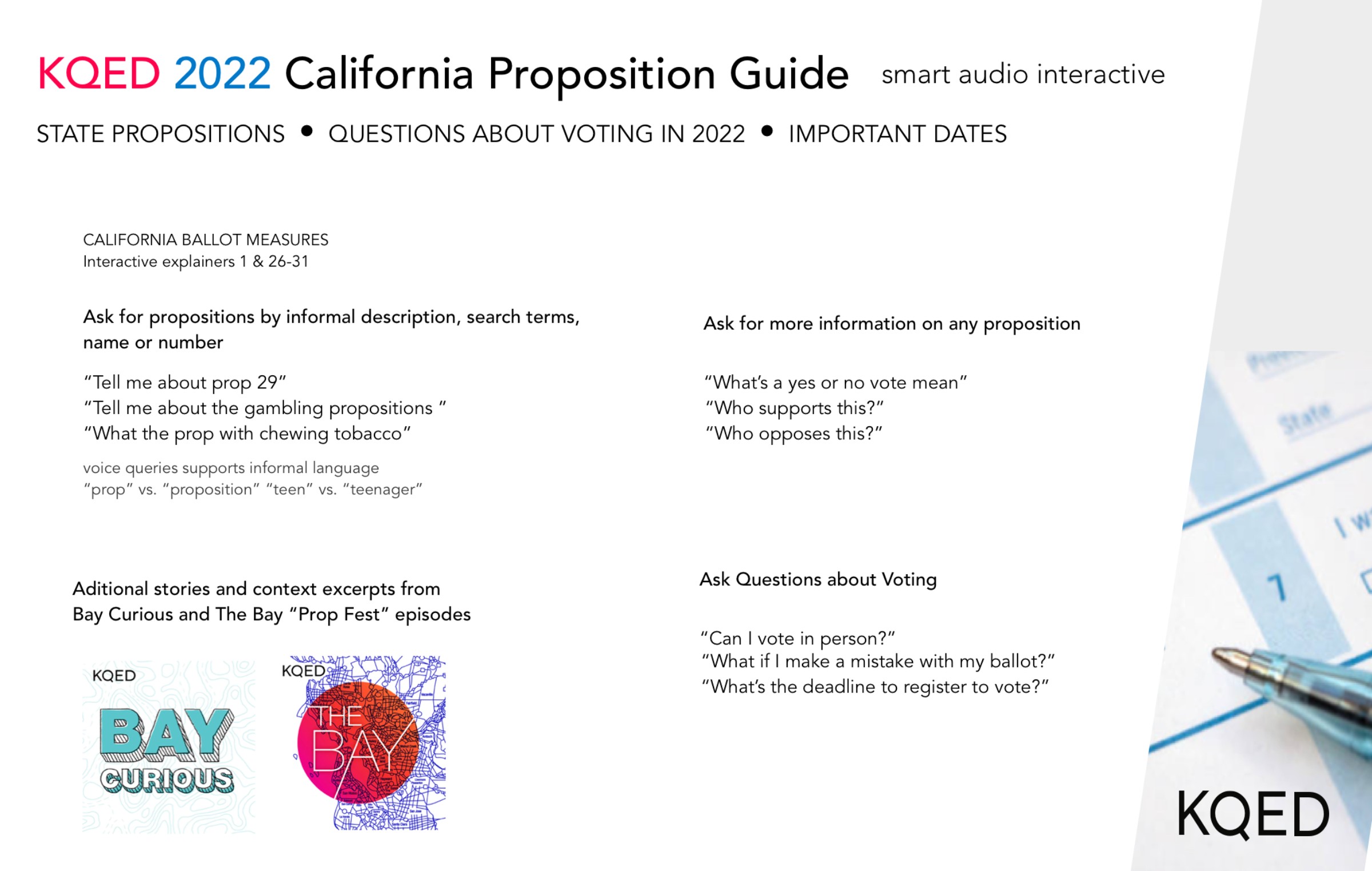
The follow-ups were the answer to the blank page. With nothing on screen telling you what you can ask for, the experience has to show you itself. “What does a yes or no vote mean” and “who supports this” were useful answers and also a demonstration of what you were allowed to ask. You only face the blank page once. After that the thing teaches you its own vocabulary, and the second question always came easier than the first.
Endorsements were part of that. Plenty of people decide by looking at who is on which side, and with twelve measures and twenty minutes that is a reasonable way to get there. It didn’t seem like our job to treat it as a lesser one.
Every measure was explained by the reporter who already covered that beat. Nine reporters across twelve measures, so the health correspondent took the dialysis measure and the politics reporters took the sentencing and bail ones. A voice you already know makes an unfamiliar interaction feel less like talking to a machine.
The guide handled more than the measures. Voting by mail, election deadlines, and pointers to related coverage, because someone who has just worked through twelve propositions is usually about to ask how to actually vote.
None of it started with recording. We mapped the paths and prototyped intent matching before a reporter went into a booth, because the audio was the expensive part. We also wrote new material for the format instead of adapting what existed, which cost more and was right, since the existing coverage answered a different question than the one voters were bringing.
What happened
Our usage in 2020 was limited, several hundred users if I remember right. I don’t have much beyond that, because we didn’t instrument it the way I would now: whether the first thing someone said got matched, whether people asked a second question, whether anyone came back as the deadline got closer.
But the idea was exciting enough to try again in 2022, in part because of the other successes we were having in voice, and also because of the rumble of technology in the Bay Area and our listeners wanting to stay at the cutting edge.
Both versions shipped before large language models were widely available. Matching “the one about dialysis clinics” to Prop 23 meant building that coverage by hand: guessing how people would phrase things, testing, finding the gaps, filling them, testing again. Within about two years of the 2022 version, that work became close to free.
Understanding what someone said was never the thing standing between a voter and a decision. Getting them to say the first thing, giving them a reason to ask a second, and choosing what comes back are all still open. Every chat product now runs into the blank page problem, and most answer it with a grid of suggested prompts, which is a menu again.
What generalizes
Match what you show to the decision the person is making, not to the structure of the catalog.
Catalogs organize themselves for the people who maintain them. The person deciding is holding a different question, usually a simpler one.
And don’t ask people to adopt your mental model.
Supporting more than one way in isn’t hard, it’s just more work, and most products decide it isn’t worth it. What it takes is accepting that people learn differently. I got that from the Exploratorium, where the whole practice rests on the fact that no two visitors come to the same thing the same way. My own instincts are useful and they would strand me if I only designed for myself. Designing purely out of research doesn’t solve it either, because findings on their own tend to arrive without empathy. The work sits between the two.
None of this arrived fully formed.
The 2020 version answered one question and raised others, and 2022 was the second pass. That iterative shape is how I work, and it is the same thing I was asking of users: you are not expected to be right the first time, you are expected to keep going.